Change Language :
Additive manufacturing processes at igus®
3D printing with self-lubricating plastics for wear-resistant parts
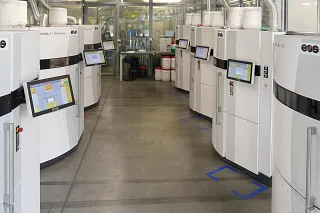
With our 3D printing service you can produce wear-resistant plastic components by means of three different processes: SLS, FDM and DLP 3D printing. On this page you will find further information on the respective production methods.
- Selective laser sintering (SLS) ▼
- Fused deposition modelling (FDM) ▼
- Digital light processing (DLP) ▼
- The manufacturing processes in practice ▼
Would you like to discuss your project with one of our experts?
Then please don't hesitate to contact us!
Selective Laser Sintering (SLS)
In SLS 3D printing, plastic powder is applied in layers with a blade and melted with a laser at the specific points where the component is to be produced. This process is characterised above all by its cost-effectiveness, fast production and high dimensional accuracy of the printed parts (from ±0.15mm).
Further advantages:
- Strength and good layer bonding
- Tough, elongation at break greater than 8%
- Delicate components with a wall thickness of up to 0.7mm can be realised
- Worldwide printing service, igus SLS systems in Germany, China and the US
Tip: Compared to the SLS process, FDM 3D printing offers a greater variety of materials.
Fused Deposition Modelling (FDM)
FDM is a 3D printing process in which a meltable material (plastic) is heated and applied layer by layer via one or more nozzles. This is also referred to as melt strand deposition or filament extrusion. The low cost of a filament printer and the usability make FDM the most widely used 3D-printing process.
Multi-material printing: with 3D printing, it is also possible to produce parts from up to four different filaments in one printing process.
Tip: if support material is not required and components with a good layer bonding and higher dimensional accuracy (<±0.2mm) are needed, laser sintering and DLP are more suitable than FDM.
Digital Light Processing (DLP)
DLP is a 3D printing process in which synthetic resin is exposed to UV light layer by layer in a basin and thereby cured or polymerised. A UV light source strikes an array of mirrors, which reflect the light as two-dimensional layer geometry and cast it onto the material.
Advantages:
- High print resolution of up to 35µm
- Isotropic mechanical specifications (no disadvantages in terms of strength due to the layer structure)
- Clean and smooth surface
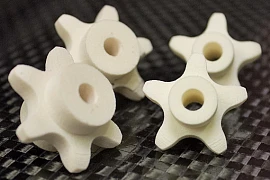
- Possible areas of application: Gears with a tooth module of 0.2 and special components that require delicate recesses, internal channels or extremely fine holes
DLP vs SLA:
A major advantage of 3D printing using the DLP process is the time saved. Compared to the SLA process, in which each point is individually exposed by a laser, the resin is cured surface by surface in the DLP process, which reduces construction time many times over. In addition, the resolution is significantly increased with up to 35µm pixels.
Consulting
I look forward to answering your questions

Shipping and consultation
In person:
Monday to Friday from 7 am - 8 pm.
Saturdays from 8 am- 12 pm.
Online:
24h
WhatsApp-Service:
Montag – Freitag: 8 – 16 Uhr