Change Language :
Medium voltage cable
Everyone has probably heard the term "high-voltage cable" - but what about a medium-voltage cable? What exactly is it, where is it used and what are its special features?
In electrical engineering, the term medium voltage is used when the electrical voltage is between 1,000V (1kV) and 30,000V (30kV). Depending on the technical standard or country, this voltage range may vary slightly as the term "medium voltage" is not clearly defined everywhere.
Where is a medium voltage cable used?

In our power grid, medium-voltage networks serve to supply a region with electrical energy. Medium-voltage networks are not used for supra-regional electricity exchange. They are the voltage levels between the high-voltage grid and the building installation. Larger electricity customers, such as industrial companies, hospitals, large swimming pools and larger broadcasting towers, usually have their own medium-voltage connections with an in-house transformer station. For railway power supplies with a traction supply voltage between 15kV and 25kV, the voltage is also referred to as medium voltage.
Large systems such as cranes or conveyor units also require medium-voltage cables for power supply. This is due to the increased energy demand. You increase the voltage to carry a lower current with the same cable. This means that the conductor nominal cross section can be reduced. However, in contrast to the cable network of the fixed installation, these applications require moving parts to be supplied with electrical energy. This requires cables that can be used to implement long travels with increasingly higher dynamics. The medium-voltage cables in these applications must therefore be designed for permanent movement.
The medium voltage cable CFCRANE
It is precisely for these applications that igus has developed the medium-voltage cable CFCRANE. It is suitable for voltages of up to 6/10KV and can achieve travels of 400m and more. Due to the materials used, the CFCRANE can be used for indoor and outdoor applications. Like all cables from igus, the CFCRANE has been put through its paces in our in-house test laboratory. With a bend radius of up to 10xd, the durability of the cable has been proven and it therefore has a guaranteed service life of four years.
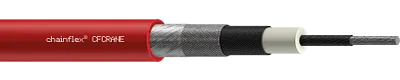
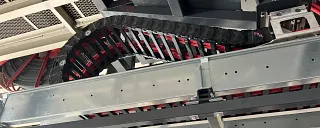
The CFCRANE has an outer jacket made of "igupren", a rubber-based material developed in-house. The model with igupren has been used successfully for decades. The material is highly abrasion-resistant and therefore ideal for energy chains. It is flame-retardant, silicone-free and makes sure that the cable has virtually unlimited oil resistance.
Guaranteed service life for the CFCRANE at a glance:
| Double strokes | 5 million | 7.5 million | 10 million | ||||
|---|---|---|---|---|---|---|---|
| Temperature | v max. [m/s] | v max. [m/s] | a max. | Travel | R min. [Faktor x d] | R min. [Faktor x d] | R min. [Faktor x d] |
| from/to [°C] | unsupported | gliding | [m/s²] | [m] | |||
| -20 / -10 | 12.5 | 13.5 | 14.5 | ||||
| -10 / +70 | 10 | 6 | 50 | > 400 | 10 | 11 | 12 |
| +70 / +80 | 12.5 | 13.5 | 14.5 |