Change Language :
iglidur® L250 - material data
The most important specifications at a glance
iglidur L250 is a plain bearing material for high speed, fast sliding movements and low coefficient of friction. The iglidur L250 material plays to its strengths particularly with low loads. Applications that make use of these advantages are fans, small motors, fast-running sensors or magnet technology.
| Descriptive technical specifications | ||
|---|---|---|
| Wear resistance at +23°C | - 🟧 🟧 🟧 ⬜️ ⬜️ + | More information on wear resistance |
| Wear resistance at +90°C | - 🟧 🟧 🟧 ⬜️ ⬜️ + | |
| Wear resistance at +150°C | - 🟧 🟧 ⬜️ ⬜️ ⬜️ + | |
| Slide property | - 🟧 🟧 🟧 🟧 🟧 + | Coefficient of friction, dynamic, against steel: µ 0.08 - 0.19 |
| Wear resistance under water | - 🟧 ⬜️ ⬜️ ⬜️ ⬜️ + | |
| Media resistance | - 🟧 🟧 🟧 ⬜️ ⬜️ + | More information on media resistance |
| Resistant to edge pressures | - 🟧 🟧 🟧 🟧 ⬜️ + | |
| Resistant to shock and impact loads | - 🟧 🟧 🟧 🟧 ⬜️ + | |
| Dirt resistance | - 🟧 🟧 🟧 ⬜️ ⬜️ + |
Temperatures
iglidur L250 plain bearings can be used at short-term temperatures of up to 180°C. Please bear in mind that a mechanical securing of the bearings is recommended from temperatures starting at 55°C. Higher temperatures can also cause the plain bearings to lose their press-fit and move in the hole.
Temperatures, coefficient of thermal expansion
| Min. application temperature | Upper application temperature, long-term | Upper application temperature, short-term | In addition secure axially from |
|---|---|---|---|
| -40°C | +90°C | +180°C | +55°C |
Permissible surface speeds
iglidur L250 has been developed especially for high surface speeds with low loads. Apart from the physical limit, which is determined by the increasing temperature of the bearing, the coefficient of wear also has a limiting effect when long sliding distances occur quickly at high peripheral speeds and the permissible wear limit is reached prematurely as a result. The maximum speeds are shown in the table.
Surface speeds of various iglidur materials
| Maximum surface speeds [m/s] | Rotating | Oscillating | Linear |
|---|---|---|---|
| Long-term | 1.0 | 0.7 | 2.0 |
| Short-term | 1.5 | 1.1 | 3.0 |
Permissible pv values
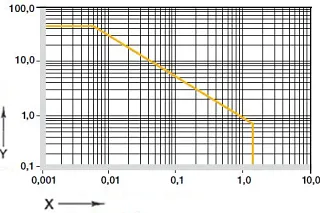
Diagram 01: Permissible pv values for iglidur L250 plain bearings with a wall thickness of 1mm in dry operation against a steel shaft at +20°C, fitted in a steel housing
X = Surface speed [m/s]
Y = Load [MPa]
Mechanical properties
The maximum recommended surface pressure is a mechanical material parameter. No conclusions regarding the tribological properties can be drawn from it. With increasing temperatures, the compressive strength of iglidur L250 plain bearings decreases. Diagram 02 illustrates this inverse relationship. Diagram 03 shows the elastic deformation of iglidur L250 under radial loads. At the maximum recommended surface pressure of 45MPa, the deformation is less than 3%. A plastic deformation can be negligible up to this value. However, it also depends on the impact.


Friction and wear
In the best pairing (with shafts made of 304 stainless steel), a coefficient of friction of 0.14 is achieved even at low loads. A coefficient of friction below 0.1 was measured even at 10MPa (Diagrams 04 and 05).
Coefficient of friction against steel (Ra = 1µm, 50HRC):
| iglidur L250 | dry | Greases | Oil | Water |
|---|---|---|---|---|
| Coefficient of friction μ | 0.08 - 0.19 | 0.09 | 0.04 | 0.04 |


Shaft materials
As seen in diagram 06, many shafts are recommendable for low loads and low rotations. The low coefficient of friction is additionally retained over a wide range of recommendable shaft surfaces finish. For loads higher than 1MPa, particular attention should be paid to the shaft material used.


Chemical resistance
iglidur L250 plain bearings are resistant to diluted alkalis and very weak acids as well as solvents and all types of lubricants.
All data at room temperature [+20 °C], + resistant 0 conditionally resistant - non-resistant
| Chemicals | Resistance |
|---|---|
| Alcohols | + up to 0 |
| Greases, oils without additives | + |
| Hydrocarbons | + |
| Fuels | + |
| Strong alkalines | 0 |
| Strong acids | - |
| Diluted alkalines | + |
| Diluted acids | 0 to - |
Moisture absorption

Installation tolerances
iglidur L250 plain bearings are standard bearings for shafts with h-tolerance (recommended minimum h9). After being fitted into a nominal size housing, the bearing's inner diameter automatically adjusts to the E10 tolerances. For particular dimensions the tolerance differs depending on the wall thickness (please see product range).
Important tolerances according to ISO 3547-1 after press-fit:
| Diameter d1 [mm] | Housing H7 [mm] | iglidur L250 plain bearing E10 [mm] | Shaft h9 [mm] |
|---|---|---|---|
| up to 3 | +0.000 +0.010 | +0.014 +0.054 | -0.025 +0.000 |
| > 3 up to 6 | +0.000 +0.012 | +0.020 +0.068 | -0.030 +0.000 |
| > 6 up to 10 | +0.000 +0.015 | +0.025 +0.083 | -0.036 +0.000 |
| > 10 up to 18 | +0.000 +0.018 | +0.032 +0.102 | -0.043 +0.000 |
| > 18 up to 30 | +0.000 +0.021 | +0.040 +0.124 | -0.052 +0.000 |
| > 30 up to 50 | +0.000 +0.025 | +0.050 +0.150 | -0.062 +0.000 |
| >50 to 80 | +0.000 +0.030 | +0.060 +0.180 | -0.074 +0.000 |
| >80 to 120 | +0.000 +0.035 | +0.072 +0.212 | -0.087 +0.000 |
| > 120 up to 180 | +0.000 +0.040 | +0.085 +0.245 | -0.100 +0.000 |
✓38 plastic bearings made of the most important iglidur materials
✓ Including iglidur L250 plain bearings
✓ Templates for finding the perfect material for your application
✓ iglidur bearing technology catalogue

Buy iglidur L250 products in the online shop
- Large selection of shapes and materials
- Available in 24 hours
- No minimum order
- No minimum order quantity
Typical application areas

Consulting
I look forward to answering your questions

Shipping and consultation
In person:
Monday to Friday from 7 am - 8 pm.
Saturdays from 8 am- 12 pm.
Online:
24h
WhatsApp-Service:
Montag – Freitag: 8 – 16 Uhr